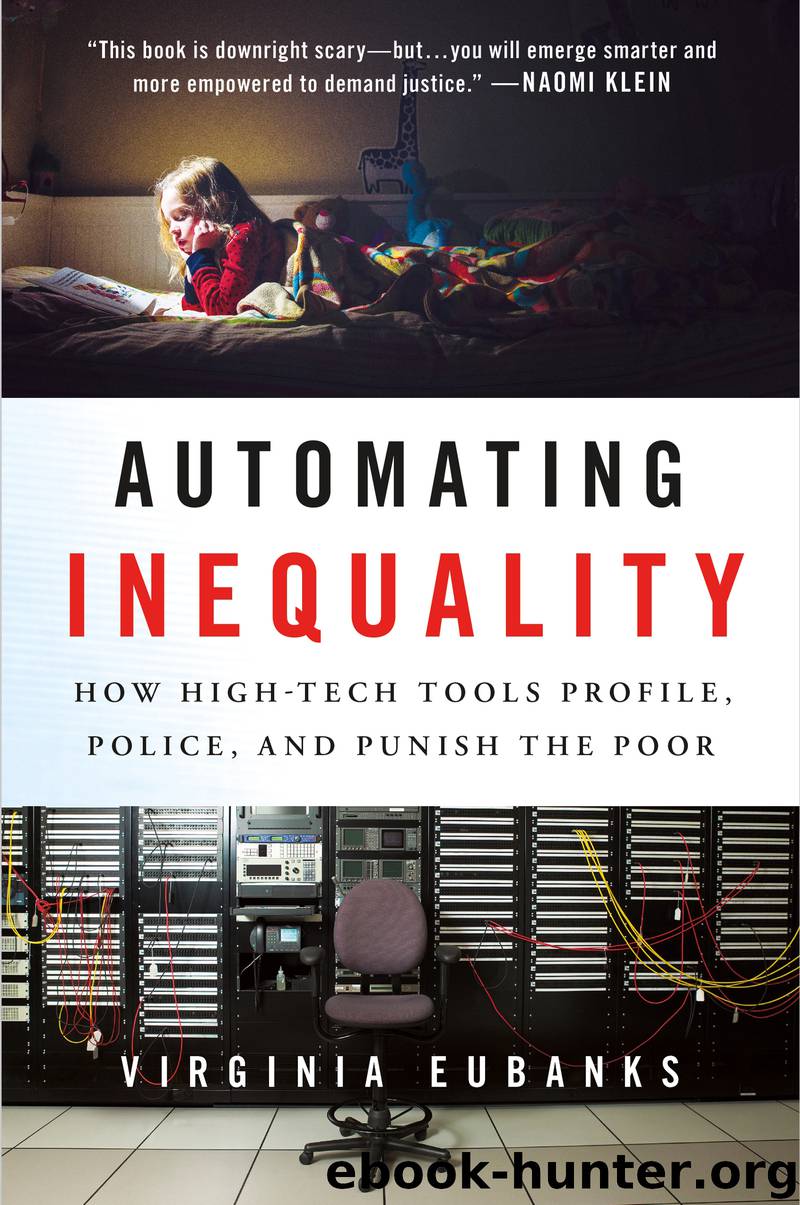
Automating Inequality by Virginia Eubanks
Author:Virginia Eubanks
Language: eng
Format: epub, pdf
Publisher: St. Martin’s Press
5
THE DIGITAL POORHOUSE
It is a warm April day in 2017, and I am walking to the public library to find pictures of the Los Angeles County Poor Farm, known today as Rancho Los Amigos. A middle-aged African American man in a pink baseball cap and a grimy hoodie stands on the sidewalk near the corner of 5th and South Grand. He moves as if buffeted by winds, arms swimming in front of him as he turns in tortured circles. He is keening: a high, surprisingly gentle sound, halfway between singing and sobbing, with no words. Dozens of people—white, Black, Latino, tourist and local, rich and poor—walk around him without even turning their heads. As we pass his swaying figure, we look away from each other, our mouths set in grim lines. No one stops to ask if he needs help.
In the United States, wealth and privation exist side by side. The contrast is particularly stark in downtown Los Angeles, where everyday urban professionals drink lattes and check their smartphones within arm’s reach of the utterly destitute. But the invisible membrane between those who struggle to meet their basic daily needs and those who do not exists in every American city, town, and village. I saw it in Muncie, Indiana, and in Munhall, Pennsylvania. I see it in my hometown.
Poverty in America is not invisible. We see it, and then we look away.
Our denial runs deep. It is the only way to explain a basic fact about the United States: in the world’s largest economy, the majority of us will experience poverty. According to Mark Rank’s groundbreaking life-course research, 51 percent of Americans will spend at least a year below the poverty line between the ages of 20 and 65. Two-thirds of them will access a means-tested public benefit: TANF, General Assistance, Supplemental Security Income, Housing Assistance, SNAP, or Medicaid.1 And yet we pretend that poverty is a puzzling aberration that happens only to a tiny minority of pathological people.
Our relationship to poverty in the United States has always been characterized by what sociologist Stanley Cohen calls “cultural denial.” Cultural denial is the process that allows us to know about cruelty, discrimination, and repression, but never openly acknowledge it. It is how we come to know what not to know. Cultural denial is not simply a personal or psychological attribute of individuals; it is a social process organized and supported by schooling, government, religion, media, and other institutions.
When we passed the anguished man near the Los Angeles Public Library and did not ask him if he needed help, it was because we have collectively convinced ourselves that there is nothing we can do for him. When we failed to meet each others’ eyes as we passed, we signaled that, deep down, we know better. We could not make eye contact because we were enacting a cultural ritual of not-seeing, a semiconscious renunciation of our responsibility to each other. Our guilt, kindled because we perceived suffering and yet did nothing about it, made us look away.
Download
This site does not store any files on its server. We only index and link to content provided by other sites. Please contact the content providers to delete copyright contents if any and email us, we'll remove relevant links or contents immediately.
| Anthropology | Archaeology |
| Philosophy | Politics & Government |
| Social Sciences | Sociology |
| Women's Studies |
Cecilia; Or, Memoirs of an Heiress — Volume 1 by Fanny Burney(32538)
Cecilia; Or, Memoirs of an Heiress — Volume 2 by Fanny Burney(31935)
Cecilia; Or, Memoirs of an Heiress — Volume 3 by Fanny Burney(31925)
The Great Music City by Andrea Baker(31911)
We're Going to Need More Wine by Gabrielle Union(19032)
All the Missing Girls by Megan Miranda(15925)
Pimp by Iceberg Slim(14476)
Bombshells: Glamour Girls of a Lifetime by Sullivan Steve(14046)
For the Love of Europe by Rick Steves(13868)
Talking to Strangers by Malcolm Gladwell(13341)
Norse Mythology by Gaiman Neil(13332)
Fifty Shades Freed by E L James(13228)
Mindhunter: Inside the FBI's Elite Serial Crime Unit by John E. Douglas & Mark Olshaker(9313)
Crazy Rich Asians by Kevin Kwan(9271)
The Lost Art of Listening by Michael P. Nichols(7487)
Enlightenment Now: The Case for Reason, Science, Humanism, and Progress by Steven Pinker(7303)
The Four Agreements by Don Miguel Ruiz(6739)
Bad Blood by John Carreyrou(6609)
Weapons of Math Destruction by Cathy O'Neil(6260)
